
Edge Computing at Work Where Data Lives: Low Latency, Smart Devices, Shared With the Cloud
When phones, sensors, and machines create torrents of information, sending everything to distant servers can be too slow and expensive. Moving computation closer to where information originates helps systems react in milliseconds, conserve bandwidth, and stay resilient, while still collaborating with centralized platforms for deeper analysis and coordination.
This story is part of Esgamesol's practical reading library across everyday topics.
1. What “the edge” really is in everyday life
From distant backrooms to nearby decision points
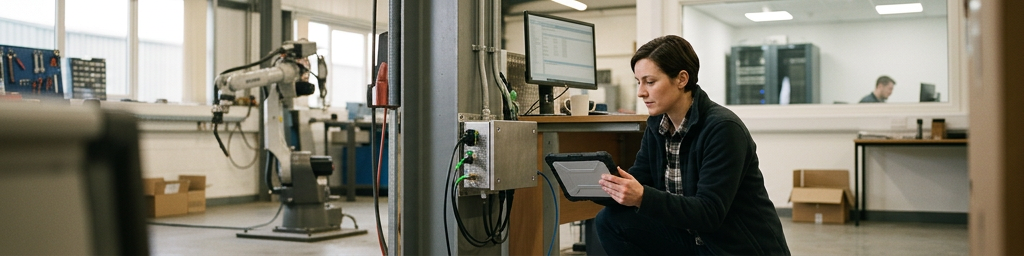
In simple terms, “the edge” is wherever information first appears: a factory line, a traffic light, a security camera, a shop floor, or a living room full of connected gadgets. Instead of acting like dumb pipes that only forward readings, these places now carry small processors, storage, and decision logic. A camera can recognize motion on the spot, a thermostat can adjust heating on its own, and a machine can watch its own vibration. Only selected, useful details travel onward to bigger platforms. The result is a network where nearby boxes and devices share the work with remote resources, instead of sending every tiny decision across half a continent.
Everyday encounters with nearby intelligence
Many people already rely on this model without naming it. Speakers that wake on a chosen word often detect that word locally before sending anything away. Doorbell cameras can identify movement, filter out passing shadows, and only upload short clips when something interesting happens. Robot cleaners map rooms and avoid obstacles without constant internet access. In each case, the first reaction happens where the information is born, while more detailed analysis, backups, or app dashboards still sit on remote platforms. Users mainly notice that things feel faster, work during patchy connectivity, and reveal less about their private environments than a constant live stream would.
2. Why delay and location are so tightly linked
When split‑second responses really matter
Delay is the quiet enemy of many connected experiences. A few hundred milliseconds may not sound like much, but that gap can decide whether a door feels responsive, a machine stops in time, or a video feed is useful in a tense moment. Every extra hop through routers, access points, and wide‑area links adds uncertainty. For weekly reports or slow dashboards, that is fine. For safety stops on machines, vehicle coordination, or immersive games, it is a deal‑breaker. Handling the most urgent steps close to devices trims those hops and cuts the loop down to a small, predictable circle that can keep running even when wide‑area links are busy or flaky.
Smoother experiences and more trust
Even when nothing life‑critical is at stake, delay shapes how people feel about technology. Smart locks that hesitate for several seconds before opening feel unreliable. Voice controls that regularly stall break the habit of using them. A camera feed that lags behind reality undermines confidence in remote monitoring. Pushing time‑sensitive reactions closer to devices reduces those stutters and pauses. People begin to trust that connected tools will respond when needed, rather than “eventually.” That trust makes it easier to introduce automation in workplaces, public spaces, and homes, because users see that the system behaves consistently instead of randomly slowing down.
3. How nearby devices think, act, and cooperate
Local sensing plus built‑in “brains”
Connected gadgets near the edge typically follow a similar pattern: they sense, think a little, and then talk. Sensors capture raw inputs such as images, sound, motion, or pressure. Small processors then clean, compress, and interpret that flood of bits. A camera might boil video down to “someone present,” “no movement,” or “blocked view.” A vibration sensor might translate noisy signals into “normal,” “warning,” or “shutdown now.” Only these compact results, plus occasional samples, move on. This saves power and network usage, and keeps the most sensitive raw signals inside devices or on local boxes instead of drifting across wide networks.
Gateways as neighborhood coordinators
Few gadgets operate alone. A local box or gateway often sits nearby, acting like a neighborhood coordinator. It listens to dozens or hundreds of devices, combines their readings, and makes broader decisions. A building controller may gather data from motion sensors, badges, thermostats, and air quality monitors to tune heating, airflow, and lights for each zone. A small on‑site server in a warehouse might combine scanner data and conveyor status to keep items moving smoothly. These coordinators handle routine work on their own, only raising their hand to remote platforms for oversight, backups, updates, or unusual events.
| Local intelligence focus | What typically runs nearby | What typically stays remote |
|---|---|---|
| Instant safety or protection | Emergency stops, door control, hazard detection | Fleet‑wide safety trend analysis |
| Smooth daily operation | Room comfort, basic access, simple routing | Multi‑site optimization and planning |
| Bandwidth‑heavy signals | First‑pass video, audio, and sensor analysis | Long‑term storage, training new models |
Local coordinators cut down on chatter and keep critical loops short, while remote services still shape policies and long‑term improvements.
4. Sharing the load between nearby nodes and remote platforms
Picking the right place for each kind of task
Central platforms and nearby nodes are good at different things. Nearby nodes excel at context‑aware, time‑critical reactions. Central platforms shine at heavy analytics, big storage, and cross‑site coordination. A balanced design sends urgent checks, simple rules, and first‑level pattern matching to local devices or gateways. Broader questions—like how similar machines have behaved over months, or how dozens of buildings compare—live in centralized tools. Urgent alerts travel upward quickly, while slower syncs carry summaries, samples, and logs when the network is free.
A learning loop between field and core
A powerful pattern emerges when both sides learn from each other. Nearby devices capture rich details and convert them into compact signals and events. Those events flow to remote analytics, which search across huge time spans and many locations for hidden patterns. Out of those patterns come new thresholds, smarter detection rules, or fresh prediction models. Updates then flow back toward devices and local gateways, which begin using that improved logic close to the action. Over time, the system becomes more precise and efficient without adding more delay or flooding networks with raw data.
| Situation | Better handled near devices | Better handled remotely |
|---|---|---|
| A sudden spike in vibration on one machine | Immediate slowdown or stop based on local rules | Checking whether similar spikes happened on other sites |
| A crowd forming at a single doorway | Adjusting doors, signs, or staff locally | Redesigning building layout after months of observations |
| A sensor behaving strangely | Local isolation and basic checks | Model updates and rule changes across the whole fleet |
This back‑and‑forth makes practical use of both sides instead of forcing every task into a single place.
5. Everyday settings where nearby intelligence shines
Workplaces, shops, and shared spaces
Production lines, warehouses, and retail spaces are natural fits. Machines with vibration and temperature sensors can warn of wear before something breaks, with local boxes making the first call to slow or stop. Only key episodes travel upstream for engineering review and planning. In stores, cameras and shelf sensors can monitor stock levels, detect queues, and trigger restocking or staffing changes automatically, without streaming every frame away. Summaries later support inventory planning, layout experiments, and service improvements across many branches, while sensitive details stay closer to the floor.
Homes, buildings, travel, and streets
Homes and offices also benefit when more decisions stay nearby. Thermostats, window shades, and lights can respond to occupancy and comfort without waiting on remote instructions, yet still share high‑level usage patterns with apps and planning tools. Door systems can keep working securely even when internet access drops. In transport and on roads, nearby hubs can coordinate signals, signs, and vehicles in response to live conditions, easing congestion before remote tools even see the full picture. Vehicles or delivery assets can adjust routes using local knowledge, then upload journey summaries to support route planning and maintenance schedules.
Q&A
-
What is real-time data processing and why is it critical for low-latency applications?
Real-time data processing handles incoming data within milliseconds, enabling instant reactions in trading, navigation, or industrial control systems. For low-latency applications, it prevents delays that could cause financial loss, safety risks, or poor user experience. -
How does local device intelligence improve distributed network systems?
Local device intelligence allows endpoints to analyze and act on data without always contacting the cloud, reducing bandwidth, improving resilience, and enabling faster, more autonomous decisions across distributed network systems. -
Why is cloud-edge integration essential for smart infrastructure technology?
Cloud-edge integration combines cloud scalability and analytics with edge responsiveness, allowing smart infrastructure to process time-critical data locally while using the cloud for long-term optimization, coordination, and large-scale data insights. -
What design principles help achieve low latency in distributed network systems?
Key principles include minimizing network hops, placing compute close to data sources, using efficient protocols, caching frequently used data at the edge, and designing stateless microservices that can be scaled and moved closer to end users. -
How can real-time data processing enable safer and more efficient smart infrastructure?
By continuously analyzing sensor streams from roads, buildings, and utilities, real-time data processing can detect anomalies, adjust operations instantly, coordinate responses across devices, and support predictive maintenance to prevent failures.