
From Genes to Species Names: DNA Barcodes Transforming Lab Work and Biodiversity Research
A short stretch of genetic code is quietly reshaping how researchers connect fragments of life to the organisms they come from. By reading this tiny tag, scientists can tell look‑alike creatures apart, survey hidden diversity, and track biological traces from wild landscapes to medical labs.
This story is part of Esgamesol's practical reading library across everyday topics.
A Tiny Genetic Tag That Stands In for an Organism
How the “tag” works inside cells
Every organism carries long strands of DNA, yet many research questions do not need that entire instruction manual. Instead, attention focuses on a short, agreed‑upon region that usually varies between species but remains fairly consistent within one species. This compact region acts like a readable label built into the genome. It does not describe every trait or behaviour, but it is distinctive enough to tell related species apart in most cases. Different organism groups may use different genetic regions, yet the logic stays the same: one small fragment, chosen because it is easy to copy in the lab and informative across many lineages.
From sample to sequence in the lab
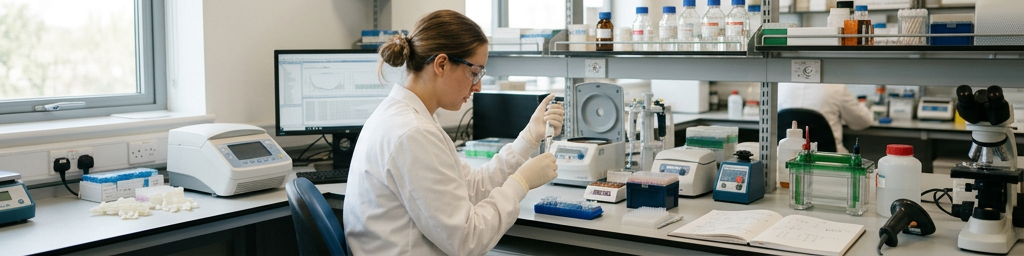
To read this label, only a small amount of biological material is required: a bit of fin, a leaf punch, an insect leg, a scrap of tissue, or a scoop of mixed environmental material. DNA is extracted, and the target region is copied many times using standard amplification methods. This is like photocopying a single page from a huge book until there is enough text to read clearly. Sequencing instruments then convert the copied molecules into digital strings of letters. Each sequence is stored together with information about where, when, and how the sample was collected, turning a physical specimen into a reusable digital record.
Why visual traits are often not enough
Relying purely on appearance can be surprisingly misleading. Closely related species may differ only in tiny details or at particular life stages, and many organisms are small, fragile, or exist mainly as larvae, spores, or microscopic cells. Field samples are frequently damaged, mixed, or incomplete: a wing fragment, a broken shell, or a few cells in a water sample. In these cases, traditional guides and photographs quickly hit their limits. A short genetic tag bypasses missing eyes, faded colours, and crumpled bodies, providing a consistent signal even when the organism itself is no longer whole.
Turning Sequences Into Biological Identities
Matching unknown tags to reference collections
Once the sequence of the tag is known, it is compared to reference libraries that link genetic patterns to named organisms. The comparison asks how similar the new sequence is to those already in the library. A close match that clearly differs from other entries supports a confident identification. If the new sequence clusters loosely among several groups, it may still reveal the broader lineage, even if the exact species name remains uncertain. The match is rarely treated as absolute truth; it is weighed alongside geography, ecology, and any remaining physical traits.
What happens when there is no clear match
Sometimes the new sequence simply does not fit existing entries. That may signal several possibilities: the organism has never been sequenced before; the reference library for that group is sparse; or what was thought to be one widespread species is actually several distinct lineages. Even without a name, the sequence becomes a stable marker for that lineage, ready to be connected later when more reference material appears. In this way, each “orphan” record highlights gaps in current knowledge and can trigger fresh taxonomic work.
Why specialists still matter
Skilled observers remain essential. When genetic results and traditional traits agree, confidence rises sharply. Disagreement, however, is often where the most interesting stories lie: hidden diversity within familiar groups, long‑standing misidentifications, or unexpected movements across regions. Specialists interpret whether a sequence difference signals a genuine species boundary or normal variation. They also help curate high‑quality reference material, ensuring that digital entries are anchored to correctly identified physical specimens rather than unchecked labels.
Libraries, eDNA, and Community‑Level Views of Nature
Building shared reference libraries
For this approach to be effective, the genetic tag itself is only half the equation; the other half is a shared catalogue of sequences tied to reliably identified material. Building such catalogues involves collecting specimens, assigning names through traditional expertise, and sequencing the chosen region. Each entry is accompanied by notes about collection site, habitat, and diagnostic traits. Coverage is uneven: large, popular groups often have stronger representation than obscure, microscopic, or hard‑to‑collect lineages. Still, coverage grows steadily, and even partial libraries can greatly accelerate identification work.
| Use case for shared libraries | Typical users | Main benefits |
|---|---|---|
| Regional fauna and flora surveys | Field ecologists, park staff | Faster, more consistent species lists across sites and projects |
| Curated museum or herbarium collections | Taxonomists, collection managers | Stable genetic references linked to physical vouchers |
| Regulatory and trade checks | Inspectors, forensic scientists | More reliable identity checks for traded biological materials |
Shared libraries are most powerful when entries are traceable to archived material that anyone can re‑examine. This traceability turns simple matches into testable claims, strengthening confidence in downstream ecological or regulatory decisions based on those matches.
Reading whole communities from environmental traces
A major extension of this approach uses environmental DNA, or eDNA. Rather than isolate individual organisms, researchers filter water, collect soil, or capture airborne particles, then extract the mixed DNA. Broadly targeted versions of the tag are amplified, producing a jumble of sequences from many organisms at once. After sequencing, computational tools separate and group related sequences, then link them back to reference entries where possible. The result is a snapshot of the biological community represented in the sample, including organisms that were never seen directly.
Tracking change over space and time
By repeating eDNA sampling across seasons, sites, or management regimes, researchers can track community changes. Some tags appear, others fade; certain lineages expand while others retreat. Because these data are tied to coordinates and time points, they can be compared with environmental measurements such as temperature, flow, or land use patterns. Shifts in the tag profiles may flag ecological disturbance or recovery before obvious visual signs appear. Still, careful interpretation is needed, since DNA persistence, shedding rates, and water or air movement can blur the precise origin of the detected signals.
Wildlife, Lab Tools, and Practical Uses
Watching animals without close contact
Working with wild animals often requires a light touch. Many species are shy, nocturnal, or live in habitats that are hard to access. Short genetic tags allow researchers to gather information from indirect traces such as droppings, hair, feathers, saliva on bite marks, or shed skin. These traces can reveal which animals passed through an area and, in some cases, what they were eating. Analysing droppings, for instance, can uncover entire menus of plants, insects, or prey species, building detailed food‑web pictures without catching the animals themselves or disturbing their routines.
Everyday lab identity checks
In everyday laboratory practice, the same concept works as a routine label. Cultured cells, microbial strains, or model organisms may gradually become misidentified or mixed. A quick check of the standard genetic region offers a way to confirm that a culture is still what its label claims. In food and product testing, the tag can reveal whether the biological components in a product match the packaging, or whether unexpected species have entered the supply chain. This reduces confusion, helps prevent costly mistakes, and strengthens confidence in experimental results and commercial products.
| Laboratory use of short DNA tags | Typical question asked | Practical outcome |
|---|---|---|
| Culture and strain verification | Is this line still the correct organism? | Fewer mix‑ups, better reproducibility |
| Product identity checks | Do ingredients match their description? | Detection of substitutions or unwanted species |
| Complex experiment tracking | Which design or treatment went where? | More efficient testing of many variants at once |
Tagging experimental tools inside organisms
The same idea also scales to highly engineered systems. Experimental particles, drug carriers, or treatment formulations can each be linked to a unique short sequence and then mixed together. After exposure in cell cultures or living models, researchers sample tissues or fluids and read which tags are present where. This reveals which designs reached particular cell types or organs. Because sequencing is sensitive and can distinguish many different tags at once, dozens of formulations can be compared in parallel, dramatically increasing the information gained from a single experiment.
Strengths, Limits, and Good Practice
What these tags are good at—and what they are not
Short genetic tags excel at questions like “what organism group is this?” and “how many distinct lineages are present here?” They are far less suitable for describing every trait, predicting behaviour, or replacing full‑genome work when fine detail is needed. In some groups, the chosen region does not vary enough to separate close relatives; in others, complicated histories such as hybridisation blur the signal. For these reasons, many projects use the tag as a first pass, then add longer sequences, other genetic markers, or traditional traits where necessary.
Why careful sampling and data handling matter
Good results begin with clean sampling. Avoiding contamination, keeping detailed notes, and separating samples that should not mix are all basic but critical steps. In the lab, controls help reveal stray DNA or technical artefacts. On the data side, transparent pipelines, open reference sets, and clear reporting of uncertainty are vital. The power of these methods lies not only in advanced sequencing machines but also in habits that make results reproducible and interpretable across teams, institutions, and regions.
Fitting this tool into the wider research toolkit
This approach works best as part of a larger toolbox rather than a replacement for other methods. Field observation, local knowledge, physical specimens, long‑term monitoring, chemical measurements, imaging, and acoustic recordings all contribute information that short DNA regions alone cannot provide. When these pieces are combined, quick genetic screening can flag patterns that deserve closer attention, while other approaches provide depth and context. Together, they turn scattered samples—from river filters to lab cultures—into a more connected picture of living systems and how they are changing.
Q&A
-
How do Species Identification Methods differ between morphology-based and DNA-based approaches?
Morphological methods rely on visible traits and expert taxonomists, while DNA-based methods use genetic markers to distinguish species, including cryptic ones, with higher accuracy and scalability, especially in large biodiversity surveys. -
What role does Genetic Sample Analysis play in modern Wildlife Research Techniques?
Genetic sample analysis allows researchers to estimate population size, relatedness, migration routes, and inbreeding from scat, hair, or tissue, enabling minimally invasive monitoring of elusive or endangered species across large landscapes. -
How does Biodiversity Cataloging benefit from Molecular Ecology Tools?
Molecular tools such as metabarcoding and environmental DNA dramatically speed up biodiversity cataloging by detecting many species from bulk or environmental samples, reducing field effort and revealing hidden diversity in understudied habitats. -
Why is Laboratory Sequence Matching critical for reliable Species Identification Methods?
Sequence matching compares unknown DNA to curated reference databases, ensuring identifications are standardized and reproducible, but it depends heavily on database completeness, sequence quality, and appropriate similarity thresholds. -
In what situations are Wildlife Research Techniques based on non-invasive Genetic Sample Analysis preferable?
Non-invasive genetic techniques are ideal when capture is risky, unethical, or impractical, such as with large carnivores or rare species, allowing population monitoring, disease screening, and movement studies with minimal animal disturbance.