
From Old Gadgets to New Resources: E-Waste Systems Closing the Loop
Old phones, laptops, and accessories rarely just vanish; they join a fast‑growing stream of discarded equipment that quietly shapes the future of manufacturing. Hidden inside are metals, plastics, and rare elements that modern facilities can separate, recover, and channel back into new chips, batteries, and connected products.
This story is part of Esgamesol's practical reading library across everyday topics.
1. Why “out of sight” gadgets still matter
1.1 The hidden stockpile in homes and offices
Drawers, cupboards, and office storerooms in English‑speaking countries hold a quiet mountain of unused devices. Each phone, laptop, router, or game console represents years of mining, refining, and manufacturing effort. When these products sit idle or end up in general trash, that effort is effectively frozen or lost. The materials inside do not vanish; they remain locked away as an “urban mine.” Treating them as a resource rather than clutter changes the story: instead of being a burden, those forgotten gadgets become a ready‑made source of metals, plastics, and components that can support new products without starting from scratch.
1.2 Beyond the bin: why simple disposal falls short
Dropping electronics into regular rubbish or tossing them in a skip might feel convenient, but it breaks the loop. Valuable metals are buried or burned, plastics are contaminated, and any hazardous substances risk leaking into soil, air, or water. On top of that, more raw materials must be extracted to feed production of replacement devices. In contrast, sending old equipment into organized treatment systems keeps materials circulating, directs reusable parts into new hands, and dramatically reduces the total footprint per device over its full life. The choice of bin versus take‑back point quietly shapes future supply chains.
1.3 A quick comparison of paths for old devices
Different choices send the same gadget down very different roads:
| Path for old electronics | Typical outcome | Relative long‑term benefit |
|---|---|---|
| Mixed household or office trash | Landfill or incineration; little to no material recovery | Lowest: value lost, higher environmental risk |
| Informal resale or unverified handlers | Uncertain data handling, unclear final destination | Mixed: some reuse, but low transparency |
| Donation without screening | Second life possible, but quality and data risks remain | Variable: depends on how devices are managed |
| Certified repair, reuse, or recycling routes | Tracked handling, secure data treatment, material recovery | Highest: supports safe circulation of devices and resources |
Choosing the last option turns an unwanted gadget into part of a managed flow of materials instead of a permanent liability.
2. How organized systems move devices from clutter to resource
2.1 Getting devices into the right hands
The first challenge is simply capturing gadgets before they disappear into general waste. In many English‑speaking regions, people have access to community drop‑off depots, periodic collection days, and retailer programs that accept old devices when new ones are purchased. Businesses, schools, and public bodies often work with services that pick up equipment in bulk and provide tracking paperwork. Mail‑back boxes and prepaid labels add an option for remote users. Across these routes, one rule is consistent: batteries need separate handling. Loose or damaged packs are isolated in special containers to prevent fires during storage and transport.
2.2 Data protection as a core part of end‑of‑life
Before a device is opened, its digital contents matter just as much as its physical parts. Phones, laptops, servers, and copiers can hold personal details, business records, or confidential documents. Reputable handlers build data wiping into their standard process: drives are securely erased or physically shredded, and organizations receive proof for audits. Individuals can help by signing out of accounts or doing a factory reset, then relying on certified services for final erasure. Treating data security as non‑negotiable makes it easier for people and companies to release equipment instead of storing it indefinitely “just in case.”
2.3 Sorting, triage, and deciding each device’s fate
Once equipment reaches a facility, it goes through a kind of medical triage. Devices are grouped by type and condition, then tested to decide whether repair, refurbishment, parts harvesting, or immediate material recovery makes the most sense. A laptop with a cracked screen but modern internals might be routed to refurbishment. A very old desktop with outdated components may head straight for dismantling. This step prevents high‑quality units from being shredded prematurely and channels limited labour and tools where they create the most value: extending product life first, then recovering materials only when use is no longer realistic.
3. Inside the treatment line: from whole devices to sorted streams
3.1 Dismantling and pre‑processing
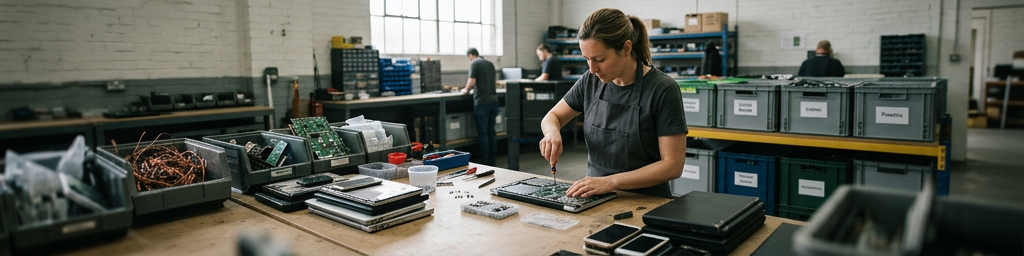
Before machines take over, workers or specialized tools remove parts that need delicate handling. Batteries, storage drives, memory modules, and easily accessible circuit boards are extracted. Cables are cut and bundled, screens are detached, and any components with known safety concerns are set aside for controlled treatment. Some removed parts are tested for immediate reuse, such as power supplies or certain modules. Others are prepared for downstream specialists. Careful manual work at this stage reduces risks later and increases the chance that valuable components remain intact enough to be used again instead of ending up as anonymous scrap.
3.2 Shredding and mechanical separation
The remaining structure of devices enters mechanical lines where it is broken into smaller pieces. Shredders reduce units to fragments; then magnets, eddy current systems, and air or density‑based separators begin teasing materials apart. Steel is drawn out magnetically, aluminium and other light metals are separated, copper‑rich fractions emerge from cables and boards, and plastics and glass form their own streams. The goal is not perfect purity but clean enough fractions that specialist plants can refine them further. Throughout, dust collection and ventilation protect workers and prevent fine particles from escaping into the surrounding environment.
3.3 Refining metals, plastics, and other fractions
After initial separation, material streams are sent to facilities tailored to each group. Steel mills melt ferrous metals for use in new structures and products. Non‑ferrous smelters handle copper, aluminium, and mixed alloys, pulling out useful metals from complex blends. Precious metal refiners treat circuit board concentrates to recover gold, silver, and palladium. Plastic recyclers sort, wash, and pelletize casings and internal parts, while glass processors deal with suitable screen and panel fragments. Not every gram can be saved, and some fractions are too contaminated, but overall the process converts mixed scrap into industrial inputs with clear, documented destinations.
3.4 What happens to hazardous elements
Some legacy displays, lamps, and components contain substances that should never be handled casually. Formal systems identify these early and route them along guarded paths. Enclosed workstations, filtration systems, and sealed containers are used to remove and package risky parts. Specialized treatment centres then neutralize or safely confine these materials according to strict standards. This controlled approach contrasts sharply with open burning or backyard dismantling, where fumes and residues can drift into homes, waterways, and food chains. Proper handling keeps both local communities and workers safer while still salvaging usable materials where it is technically feasible.
4. What actually gets recovered from old equipment
4.1 Metals: the backbone of new infrastructure
Inside outdated gadgets lies a surprising amount of everyday industrial metals. Steel frames, screws, and brackets provide structure; aluminium housings and heat sinks manage weight and cooling; copper runs through circuit boards, connectors, and cables. When these metals are recovered, they can feed into new wiring, building frames, appliances, and of course fresh electronics. Producing metal from recycled scrap typically demands less energy than from newly mined ore. For regions with ambitious climate goals, that reduction matters. It also cushions supply against disruptions in raw extraction by turning cities themselves into large, distributed sources of metal.
4.2 Tiny layers, big impact: precious and specialized metals
Circuit boards, connectors, and certain components rely on tiny amounts of high‑performance metals. Gold plating resists corrosion on contacts, silver improves conductivity, and palladium appears in some board elements. In a single phone, the quantity is small; across millions of devices, it becomes a rich vein. Specialized smelters extract these metals from concentrated board scrap and sell them back into sectors like electronics, medical equipment, and industrial tools. Because the concentration of precious metals in collected boards can rival or exceed that of some mined ore, recovering them efficiently is both economically and environmentally attractive.
4.3 Plastics, glass, and flexible materials
Casings, keys, internal brackets, cable sheathing, and some insulation rely on a wide variety of plastics and rubbers. Screens and certain optical components contain glass. These materials are trickier to handle because they come in many grades with different additives. Modern plants try to sort plastics by type where possible, then clean and reprocess them into pellets used for new parts, construction products, or non‑critical items. Glass from suitable displays can be turned into new glass products or industrial fillers. While the value per kilogram may be lower than for metals, these streams still help reduce demand for virgin plastic and cut overall waste volumes.
4.4 Batteries and energy‑rich components
Rechargeable packs from laptops, phones, and tools are usually removed and treated separately. Specialist facilities extract metals such as nickel, cobalt, and lithium from certain chemistries, plus steel and other casings. Putting these materials back into circulation is increasingly important as demand for energy storage grows. Safe collection, transport, and processing are essential, because damaged or improperly stored batteries can overheat or ignite. Good systems in English‑speaking countries typically provide clear instructions and separate drop‑off points for different battery types, making it easier for households and businesses to avoid risky behaviour like tossing packs into general rubbish.
Q&A
-
What is Electronic Device Recovery and why does it matter for sustainability?
Electronic Device Recovery means collecting and processing discarded gadgets so their components, materials, and data are safely handled and reused, reducing e‑waste, conserving resources, and cutting the environmental footprint of tech consumption. -
How does Responsible Tech Disposal differ from simply recycling electronics?
Responsible Tech Disposal goes beyond basic recycling by ensuring secure data wiping, safe handling of hazardous materials, compliance with regulations, and prioritizing repair, reuse, and certified recyclers over informal or landfill disposal channels. -
What role does Material Sorting Technology play in Circular Electronics Management?
Material Sorting Technology uses sensors, robotics, and AI to separate metals, plastics, and rare materials with high precision, enabling efficient recovery, higher material purity, and cost‑effective circular flows in electronics supply chains. -
How can companies implement Sustainable Hardware Processing in their IT lifecycle?
Companies can design for disassembly, track assets, partner with certified refurbishers, use energy‑efficient recovery processes, and adopt take‑back or buy‑back programs that extend device life while maximizing safe material recovery at end‑of‑use. -
What is Resource Reuse Infrastructure and how can cities build it for electronics?
Resource Reuse Infrastructure includes collection hubs, refurbishment centers, certified recyclers, and logistics networks that keep devices and components circulating; cities can develop it through public‑private partnerships, standards, and targeted incentives.