
Tracing Tiny Plastics From Shoreline Samples to Ocean Ecosystem Change
Tiny fragments of broken-down plastic now drift through seawater almost everywhere, from busy harbors to open ocean currents. Researchers track these particles by collecting water and shoreline material, then examining them in the lab to see what they are made of and how they affect ocean life.
This story is part of Esgamesol's practical reading library across everyday topics.
From broken items to drifting specks
What these fragments are made of
In everyday terms, these particles are just very small pieces of plastic, often smaller than a grain of rice. Some began life tiny, as industrial pellets or scrubbers; others started as bags, bottles, or fishing gear that cracked, peeled, and frayed under sun and waves. Instead of disappearing, they simply split into countless bits. Different shapes tell different stories: hard shards from packaging, thin films from wrappers, fibers from clothing or ropes, and foams from insulation or food containers. Their density and surface roughness decide whether they float near the top, hang in mid‑water, tangle with seaweed, or sink into mud. Many carry additives such as colorants or softeners, and over time they can also pick up other substances dissolved in seawater, turning each speck into a tiny, mobile cocktail of material and chemistry.
Why coasts are crucial entry points
Coastal zones act like funnels and mirrors at the same time. Street litter, worn tire dust, synthetic fibers from laundry, and fragments from outdoor plastics are washed into storm drains, rivers, and estuaries, where they mix with fishing debris and shoreline litter. Waves repeatedly bury and uncover them in beach sand, while tides push them into salt marshes, mangroves, and rocky pools. These places are rich nurseries for shellfish, juvenile fish, and many invertebrates, so the chance of contact with drifting fragments is high. Because coasts sit between land and sea, the mix of particle types often reflects nearby habits: more fibers near densely populated areas, more net fragments where boating or fishing is intense. For researchers in English‑speaking regions, from temperate estuaries to colder rocky shores, these nearshore environments provide accessible “listening posts” for tracking how everyday activities on land echo through the water.
How researchers collect particles in the field
Beach surveys and shoreline sand
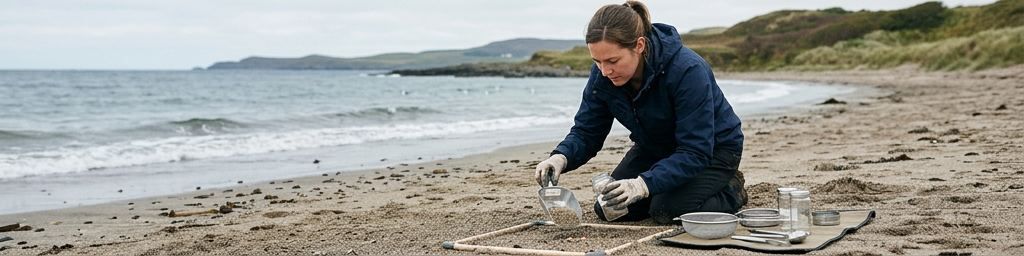
On beaches, work often begins with simple, repeatable routines. Teams mark out fixed squares or transects on the upper shore, scoop the top layer of sand into containers, and record location, tide, and recent weather. Back in the lab, the sand is dried, mixed with salty solutions so lighter plastic floats, then sieved and filtered. Larger pieces can sometimes be seen by eye on the beach, especially brightly colored ones near the strandline, but smaller particles hide among grains. Using set plots rather than just “picking what you see” lets scientists compare different bays and track changes over months or years. Patterns in shapes and colors may hint at sources: threads similar to synthetic textiles, blue shards reminiscent of crates or lids, or green fibers matching common fishing gear. Shoreline surveys therefore provide both a pollution snapshot and a first clue about where the pieces originated.
| Shoreline survey focus | What it is useful for | Typical limitations |
|---|---|---|
| Fixed sand plots | Tracking trends at specific beaches over time | Misses deeper buried particles |
| Visual item counts | Engaging volunteers and mapping large debris | Overlooks tiny or transparent pieces |
| Mixed sand–debris sampling | Linking fragments to nearby human activities | Requires lab access and trained sorting |
These different approaches are often combined, giving both community‑friendly activities and detailed scientific data from the same coastlines.
Surface waters, nets, and bottles
In shallow bays and near harbors, researchers often sample the upper water layers using fine‑mesh nets or carefully filled bottles. Nets are towed gently behind small boats or from piers at the surface, catching particles above a chosen size while letting most plankton and water pass. The tow distance, speed, and net opening are recorded so that the volume of filtered water can be estimated later. For smaller particles or specific depths, bottles that close at set points in the water column are lowered on lines, then brought back for filtration on board or in the lab. Pumps and inline filters can also pull known volumes through very fine meshes, capturing particles too small for typical towing nets. Because tides, storms, and currents move plumes of pollution around, repeated sampling at different times is essential. A sheltered bay in an English‑speaking coastal region might show low counts after calm weather, then spike after heavy rain flushes urban runoff through rivers and drains.
Beyond the coast: offshore traces
Further offshore, sampling becomes more logistically demanding but reveals wider patterns. Research vessels follow routes from the coast toward deeper water, taking surface and subsurface samples at regular intervals. Comparing nearshore and offshore data helps answer simple but important questions: how quickly fragments leave busy coasts, which current paths they follow, and where they tend to pile up. In deeper areas, instruments collect sediment from the seabed, sometimes as cores that preserve layers laid down over many years. Within those layers, the appearance of plastic fragments and fibers marks the growing human footprint on the seafloor. Drifting buoys and autonomous platforms occasionally carry sensors and samplers, adding extra pieces to the puzzle. When results from many voyages are assembled, maps emerge that show not only infamous accumulation zones, but also lesser‑known corridors through which small plastics travel between regions and across ocean basins.
Inside the lab: turning fragments into information
Separating plastic from sand, silt, and life
Raw environmental samples are messy mixtures. Sand, shell pieces, algae, and the remains of tiny animals all sit alongside plastic. The first task is gentle cleaning that removes as much non‑plastic material as possible without destroying fragile particles. For sandy samples, density separation is common: the mix is stirred into dense salty water, heavier minerals sink, and floating material is poured off and filtered. For water samples, filtration usually comes first, trapping particles on membranes with known pore sizes. To clear away clinging organic matter, mild oxidizing chemicals or enzymes may be applied, carefully chosen so they digest natural tissues but leave plastics mostly intact. Throughout, lab teams must guard against contamination from clothing fibers, airborne dust, or plastic tools. Many use cotton‑based lab coats, covered glassware, and procedural blanks processed alongside real samples, so any background particles can be detected and accounted for during analysis.
Visual sorting and spectral “fingerprints”
Under microscopes, many particles stand out. Fibers are long, thin, and often evenly colored; fragments are jagged; films fold easily; foams show tiny bubbles. Technicians photograph, measure, and classify them into shape categories, building size distributions that show whether a sample is dominated by coarse pieces or very fine dust‑like particles. But looks can deceive: some natural fibers mimic synthetics, and weathered plastics can resemble shell or plant matter. To be sure, laboratories turn to instruments that read a particle’s spectral signature. Infrared or Raman systems shine light on a speck and capture how its molecules vibrate, producing a pattern that can be matched to reference libraries for polymers like polyethylene, polypropylene, or polyester. Automated setups can scan many particles on a filter, rapidly mapping which materials are present. This step transforms a simple count into a chemical inventory, tying fragments to likely uses such as packaging, fishing gear, or textiles.
What sticks to the surface
Beyond counting pieces, researchers often ask what else accumulates on or within them. In seawater, plastic surfaces quickly host biofilms of bacteria, algae, and tiny invertebrates. These “rafts” can be examined with genetic tools to see which species use them and whether they differ from those on natural materials. At the same time, some dissolved substances may concentrate on plastic surfaces, including certain organic compounds or elements. By extracting and analyzing these coatings, scientists explore whether plastic acts mainly as an extra transport surface or plays a stronger role in moving substances through marine food webs. Early work suggests the answer varies with location, water chemistry, and particle type. Still, the idea that each speck may carry not just solid material but a thin halo of life and chemistry is now central to laboratory investigations.
Living with plastic: effects on aquatic life
Encounters from plankton to predators
Marine organisms meet drifting fragments in many ways. Tiny filter‑feeders draw water past their feeding structures and can trap particles mixed with real food. Grazing snails and sea cucumbers may take in particles resting on sediments. Small fish and larger predators sometimes mistake bright specks for prey. In controlled experiments, ingested pieces often pass through digestive tracts, but not always harmlessly. They can take up space needed for energy‑rich food, irritate tissues, or alter feeding behavior. Some very small fragments may cross gut walls and enter other organs. For early life stages, including larvae and juveniles, even short‑term exposure can influence growth or survival, because their bodies are tiny and energy budgets tight. Across coastal waters in English‑speaking regions, from shellfish beds to kelp forests, many commonly harvested species now live in environments where synthetic particles are an everyday background feature.
Habitat changes and subtle shifts
Impacts are not limited to ingestion. When large numbers of particles float near the surface, they can darken the water slightly or change how light scatters, with possible consequences for microscopic algae that rely on sunlight. When particles settle into muddy bottoms or sandy flats, they mix into the structure of sediments and can affect how easily oxygen, nutrients, and small animals move through the top layers. Burrowing worms, small crustaceans, and seagrass roots may all experience these changes differently. On hard surfaces, fragments can wedge into crevices or cling to seaweed and corals, sometimes altering how larvae attach or how surfaces erode. These effects are often subtle and cumulative, making them harder to spot than dramatic images of entangled animals, but they can slowly reshape local communities. Long‑running field studies and experiments are beginning to connect small‑scale changes in behavior and habitat quality with broader patterns in coastal ecosystem health.
Q&A
-
How can Marine Pollution Sampling be designed to give reliable, comparable data across different coastlines?
Use standardized sampling depths, bottle types, timing (e.g., tidal stage), and QA/QC protocols, combined with GPS-referenced stations and duplicate samples, so datasets from different regions can be statistically compared and merged into global assessments. -
What factors are critical when planning Coastal Water Testing near urbanized shorelines?
Key considerations include stormwater outlets, shipping lanes, bathing areas, and diurnal tides; sampling should align with peak human use, rainfall events, and known pollution sources to capture realistic exposure and guide local management actions. -
Which laboratory techniques are most effective for Plastic Particle Analysis in seawater samples?
Common workflows combine density separation, oxidative digestion of organics, filtration, then microscopic sorting with FTIR or Raman spectroscopy, which accurately identify polymer types and sizes, enabling source tracking and risk evaluation. -
How do Ocean Cleanup Studies ensure that debris removal does not harm marine life?
Researchers pair removal trials with bycatch monitoring, sonar or camera systems, and pre-deployment ecological surveys, then adjust towing speed, net mesh, and exclusion devices to minimize impacts on fish, plankton, and sensitive habitats. -
What Environmental Science Methods are used to assess Aquatic Ecosystem Impact from chronic pollution?
Scientists integrate water chemistry, bioindicator species, tissue contaminant analysis, sediment cores, and ecological modeling, allowing them to detect long-term shifts in food webs, biodiversity loss, and sublethal stress that simple spot tests might miss.