
From Driveway to Highway: Keeping Kids Secure in Everyday Car Travel
A quick trip to school, a grocery run, a weekend highway drive—every journey asks the same question: is your child truly protected? Small bodies face big forces in sudden stops, and tiny mistakes in setup can decide whether a crash becomes a close call or a life-changing injury.
This story is part of Esgamesol's practical reading library across everyday topics.
Everyday rides, real risks: why “it’s just a short drive” is a trap
Small crashes, big consequences for small bodies
Most family miles are short hops: school runs, daycare drop‑offs, sport practice, errands. Roads feel familiar, traffic seems slow, and it is tempting to relax: “it’s only five minutes,” “I’ll just hold the baby,” “they can skip the belt this once.” Yet sudden braking, low‑speed rear‑end hits, or side swipes can throw an unsecured child with huge force.
Children are not just “small adults.” Their heads are proportionally heavier, necks and spines less robust, ribs and pelvis still developing. Adult belts aim forces at strong bones in grown bodies; on a child, the same belt can cut into the neck or abdomen. A well‑used child seat or booster spreads crash forces to the chest, shoulders, and hips, and keeps the head and torso inside a protected shell instead of flying forward.
Making “seat first, then start” a non‑negotiable rule
The safest technology fails if it is used only “for big trips” or when there is plenty of time. Grandparents, friends, or neighbors who help with school pick‑ups may not realise that the quick lift home is often when corners are cut. Treating the child restraint as a permanent part of the car, not an optional extra, changes that mindset.
A simple home rule helps: the engine never starts until every child is in their own seat, buckled properly. No exceptions for tears, lateness, or “just around the corner.” Over time, children build a powerful reflex: climb in, find their place, buckle up, then talk about snacks or songs. That muscle memory protects everyone on the chaotic mornings when adults are most distracted and mistakes are most likely.
Where children sit: making the back of the car work for you
Back row over front: distance from danger
Inside one vehicle, not all spots are equal. For younger passengers, the rear row usually offers better protection than the front. It sits farther from common crash zones and away from powerful front airbags designed for adult bodies. An airbag that can save a tall driver in a frontal impact may seriously injure a small child sitting too close.
Families sometimes prefer the front so a fussy toddler is easier to see or hand things to. Yet this convenience swaps reduced fuss for higher risk and more driver distraction. Positioning children behind, then using mirrors, calm conversation, or safe pull‑overs, balances care with safety. Even once a child is physically big enough for the front, keeping them behind for as long as practical adds a useful safety margin.
Back‑row seating choices when space is tight
In many cars the middle of the second row is slightly further from doors, giving extra distance in side impacts. If that spot allows a firm installation using seat belt or lower anchors, it can be an excellent choice for a single child or the youngest sibling. But “middle is best” only applies if the seat actually fits there. A narrow, raised cushion, odd belt routing, or missing anchors can make the centre position a poor match for some restraint designs.
When several children share the vehicle, parents juggle safety with everyday usability. A common pattern is: the smallest or rear‑facing child in the most protected position; bigger children using boosters or belts on the outer seats; older, more independent riders where access is easiest. Third rows can be used safely when the car manual allows child restraints there and the belts or anchors are suitable. The real priority is not a perfect diagram, but solid installs for every seat in the configuration your family actually uses.
Back‑row layouts: matching children to seats
The choice is not simply “front or back,” but how the whole row is laid out. This quick comparison highlights typical trade‑offs:
| Back‑row layout option | Typical advantages | Possible compromises |
|---|---|---|
| Youngest in centre, bigger kids on sides | Extra side‑impact distance for the most fragile child; older siblings can climb in and out more easily | Harder for adults to reach centre; some cars make firm centre installs tricky |
| All children on outer seats | Simple access through doors; easy to help buckle from the sidewalk side | Slightly closer to side impacts; may be limited by door shape or belt paths |
| One child in third row | Spreads children out; useful for car‑sharing and car‑pools | Harder to supervise; access in emergencies needs planning |
Whatever layout you choose, check the vehicle manual for which spots are approved for each type of restraint and how anchors or belts must be used. Printed diagrams in both the car guide and the seat booklet often answer questions more clearly than online opinions.
Buckles, belts, and anchors: getting “secure enough” in real life
Using the belt path correctly, every single time
Child restraints rely on two systems at once: the internal harness for the child, and the way the whole shell is attached to the car. Many products accept either the vehicle belt or lower anchors, but usually not both together unless specifically allowed. The key is routing and tightening correctly, not stacking systems.
For belt installations, pull the belt through the right channel for either rear‑facing or forward‑facing mode; mixing them up shifts crash forces to the wrong areas. Then engage the belt’s locking feature so it cannot quietly loosen as the car moves. Once tightened, grip the seat close to the belt path and rock it side‑to‑side and front‑to‑back. If it moves more than roughly a small hand’s width at that point, it likely needs more tension.
Understanding anchors and that “mysterious top strap”
Lower anchors give a simple clip‑on option in many back seats. They only work when attached to the correct metal bars hidden at the seat bight, not to nearby cargo loops or random brackets. After clipping on, push down with your body weight and pull the connector strap tight, then repeat the same wiggle test at the anchor path.
Forward‑facing restraints usually include an extra strap at the top that hooks to a tether point behind or above the seat. Many caregivers ignore it or assume it is optional. Yet that single strap can dramatically cut how far a child’s head pitches forward. In serious braking or impacts, reducing that pitch by even a small distance can matter for neck and brain safety. Spending a few minutes to find the tether anchor and learn how to tighten it is one of the highest‑value safety upgrades available.
Harness and belt fit on the child’s body
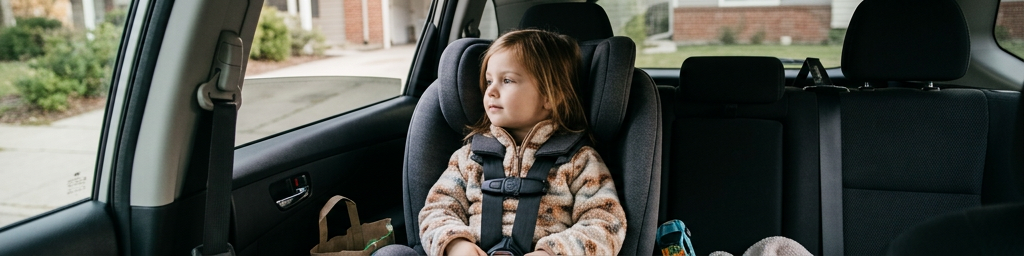
The internal harness must fit the child at their current size, not how big they will be next season. For rear‑facing, shoulder straps generally sit level with or just below the shoulders; for forward‑facing, usually at or just above them. Chest clips should rest at armpit height, not against the neck or over the belly.
Loose, twisted straps are a common weak link. A simple daily check helps: after tightening, try to pinch the harness webbing at the collarbone. If fingers can grab a fold of slack, the straps are not snug enough. In cool climates, thick coats can hide slack, so it is safer to buckle over thinner layers and place blankets over the harness rather than under it. For older children in boosters, confirm that the lap portion lies low across the hips or upper thighs and the shoulder portion runs across the centre of the chest and shoulder, not the face or armpit.
Turning rules into habits: calm, consistent parenting on the road
Helping children cooperate with restraints
Even the best setup fails when a child constantly slips arms out of straps or unclips buckles. Instead of endless lectures about danger, frame the restraint as part of everyday family life: “Everyone has a special place in the car,” “The car only moves when everyone is clicked in.” For toddlers, turning the seat into a personal “travel nest” with a familiar blanket or small soft toy can shift focus from restriction to comfort.
When children test limits by loosening belts or pressing the buckle, respond with actions, not arguments. Pull over in a safe place, calmly reset the belt, and explain that the car cannot go while it is open. Repeating this pattern—no movement without full restraint—connects their choice with a boring outcome rather than a big drama, which often reduces repeat attempts.
Taming clutter and planning for different drivers
Loose toys, drink bottles, and gadgets can fly through the cabin during hard braking. Keep heavier items low and secured, and choose soft, lightweight toys within reach. Use seat‑back pockets or small organisers rather than scattering things across cushions next to the child. For curious kids who like door handles and window switches, child locks and window locks quietly remove one more source of risk.
Many families rely on multiple cars or caregivers. Each additional vehicle is another chance for mistakes. When possible, assign one main car to carry the most complex seats, and use simpler but approved restraints in secondary cars. Practice installing each seat in daylight when there is no rush, so swapping vehicles before an early activity or late pick‑up does not become a stressful, error‑prone scramble.
With a little planning, buckling in becomes as automatic as brushing teeth. Journeys then feel less like a gamble and more like a routine part of caring for growing bodies—whether you are rolling down the driveway or merging onto a busy highway.
Q&A
-
How can I check if my child’s car seat has a truly secure seat installation?
Gently rock the seat at the belt path; it shouldn’t move more than an inch. Confirm you’re using either ISOFIX/LATCH or the seat belt, not both, and follow the manual plus your vehicle guide. -
What are the most overlooked aspects of family vehicle safety beyond car seats?
Parents often miss securing loose items, checking tire condition, and setting child locks. A quick pre-drive routine and regular vehicle maintenance greatly reduce everyday risks. -
Why is rear seat protection important for kids and how can I improve it?
The rear seat is safest, but needs side-impact protection, head support, and seat-back stability. Use high-back boosters, adjust headrests correctly, and avoid hard accessories on seat backs. -
How do age-appropriate car restraints change as my child grows?
Start with rear-facing as long as possible, move to forward-facing with a harness, then a booster until the seat belt fits correctly, usually when the child reaches 145–150 cm in height. -
What does safe travel preparation look like for everyday parenting on the road?
Plan routes, allow extra time, pre-pack essentials, and buckle everyone before moving. Avoid handing kids hard or choking-hazard toys and model calm, focused driving every trip.